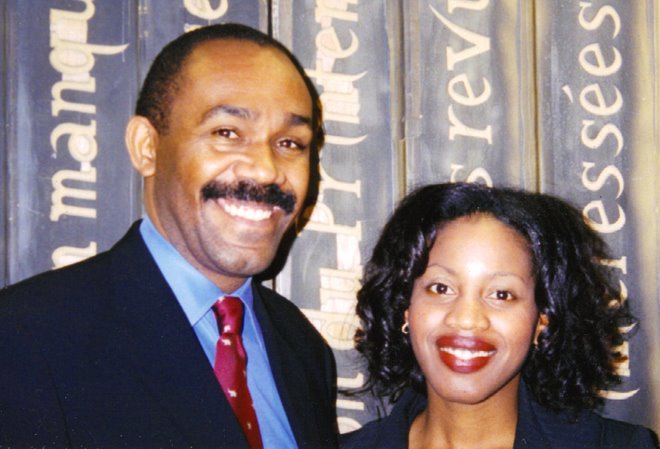
On January 11, I participated in a panel on the Crosstalk program on Russia TV with two other panelists, Marguerite Laurent alias Zili Danto of the Haitian Lawyers’ Association and former advisor to Jean-Bertrand Aristide, and Nicolas Rossier, an independent filmmaker. The panel was to provide an assessment of Haiti one year after the earthquake and focus on the failure of international aid. Largely, the goal seemed to be to blame the international community for their failings in Haiti while dismissing the failure of the Haitian Government by further blaming the international community for destabilizing and delegitimizing Haitian leaders.
On the panel – and it seems throughout the coverage of the earthquake – there was consensus that international aid has failed Haiti in the aftermath of the earthquake and more broadly over the past 20 years. Recovery has been a slow, unfocused and uncoordinated. Further, Haitians have been completely marginalized from the process (see: http://solutionshaiti.blogspot.com/2011/01/haiti-one-year-after-earthquake-by.html ). Again, we can all agree on this. But we should also point out that the international community played a pivotal role in the immediate aftermath of the earthquake and did commit significant funding to the rebuilding process. More than half of American households donated to the recovery for which the country is eternally grateful.
However, we cannot dismiss the total failure of Haitian governance and leaders over the past 20 years. The Duvaliers, Aristide and Preval have all pursued personal enrichment and power by leading corrupt and violent regimes that have stolen the meager resources of the country. Madame Marguerite Laurent rightly pointed out that Haiti’s leaders are not solely to blame for corruption; there is a ruling class in Haiti that controls all economic activity. She says they are “light-skinned Syrians”, which is untrue, however. The group she refers to is a corrupt business cartel known as the “Groupe de Bourdon”, comprised of 17 foreign-educated and wealthy individuals from the banking and commercial sectors who control more than 90% of the country’s economic activity while paying only 4% of the taxes. The Haitian leaders and this cartel conspire to maintain a stranglehold on Haiti’s economy through political manipulation, monopolies, barriers to securing credit, and, when all else fails, intimidation and violence. They are at the source of all political crises and instability in Haiti. Typically, frustration amongst the people mounts throughout an administration and revolt and instability erupts as a result of a rigged election.
International involvement in Haiti’s myriad political crises, however, has come at the official request of Haitian presidents when they have become desperate to preserve power or flee from the angry masses. The US was dragged into the Aristide debacle in 2004 at his request. Aristide requested to be evacuated because he knew the people were fed up with his corruption. The rebels he created earlier to repress the people turned against him and were coming for him. He manipulated and used the international community to prop up his regime many times, and then claimed his was kidnapped or the foreigners were meddling in the country. Preval continues Aristide’s legacy. The OAS has no authority to interject into the electoral process of Haiti. Their involvement has came at the official request of Preval, who is gambling on being able to manipulate the organization to get a stamp of approval on his electoral coup, for more see: http://solutionshaiti.blogspot.com/2010/12/haitis-elections-2010-recounting-fraud.html . He feels he has a majority of the Latin American leadership on his side, given a number of leaders’ track records of manipulating elections in their own countries (Chavez in Venezuela, Ortega in Nicaragua and so on). Involving the OAS in this debacle is Preval’s last-ditch effort to ram through his electoral coup.
Perhaps the panelists do not well understand the OAS procedures and mandate here so it is worth taking a moment to elaborate the point. Preval requested that the OAS issue a report of recommendations on how to resolve the electoral crisis. Given the blatant fraud and public unrest, he needs a way out. The OAS will share a draft report with the Haitian Government to get their consensus and sign off. They cannot issue the report without the approval of the Haitian Government. In other words, Preval can reject their report and modify all the language before it is issued ensuring that it says exactly what he wants it to. Then the report goes to the 33 members of the permanent council for consideration and ratification. Preval believes he has a majority of the leaders in the region on his side as they have a good track record of stealing elections themselves. And, he is betting that the US and Canada will play a diplomatic role in the interest of stability in the country. If and when this report destabilizes the country, the OAS has surely played a role, but the ultimate blame resides with Preval for dragging them into the fight.
The only way forward is for Haiti to show some leadership and for Haitians to work together to pull themselves out of this mess. The panelists attempts to be divisive only distract us from the real issue: Haiti is in shambles, and our countrymen need our help. It seems that just when things cannot get any worse – they do.
The international community will act in its own self-interest – and so must we. We all agree that international organizations are ramming through their priorities for Haiti – rather than addressing the priorities of the Haitian people. How do we fix that? Haitians develop a plan of national priorities and then stipulate that aid programs must demonstrate a clear link to advancing Haiti’s priorities. We all agree that international organizations are leveraging Haiti to secure funding for their organizations and programs and Haitian institutions are not benefitting at all financially or through capacity building. How do we fix that? The Haitian government needs to step up and stipulate that any aid programs and major projects must include Haitian participation and must demonstrate capacity building. We all agree that former President Clinton has a confusing number of titles and has done a lot to secure his role in reconstruction but little to make sure it moves forward. He was all over the news yesterday expressing his disappointment in how slow the process is going – a process that he largely controls! How do we fix this? By getting together, speaking with one voice to pressure him to step up the pace of recovery. And, by restructuring this Haiti Interim Reconstruction Commission (IHRC), which we all agreed was ineffectual, so that the Haitian ministers, private sector and Diaspora are represented.
Currently the Haitian government leaders have no political will to do any of this or to take real responsibility for the leadership of their country. Why? They benefit from the status quo. Their priority is not Haiti – it’s themselves. They believe that awarding no-bid contracts to international players curries favor with international players and ensures a quid pro quo down the line.
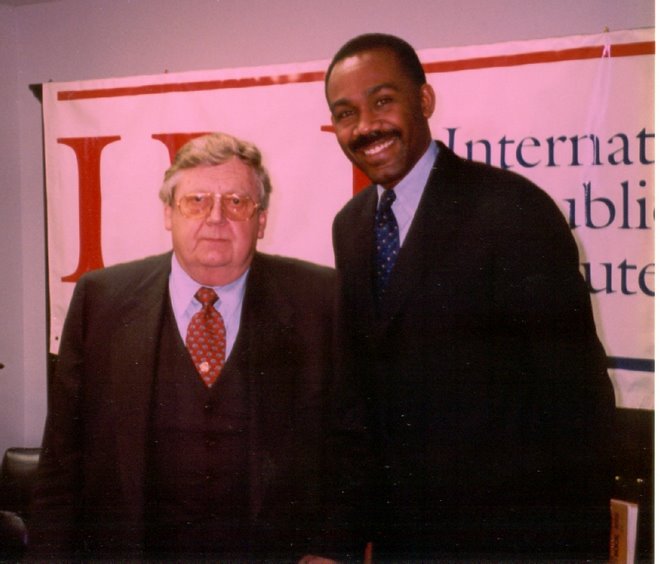
Finally, the debate unfortunately got personal with both panelists attacking me by characterizing me as an operative of the “US right-wing imperialist white supremacists”. This is ludicrous. Five years ago I worked for the International Republican Institute, www.iri.org a non-partisan, non-governmental organization. IRI is in no way a part of the US Government or the USAID as many have charged. I am a Haitian citizen. I do not have US citizenship. So why would US partisan political agendas matter to me? What do I stand to gain as a Haitian outsider? I worked with IRI because the organization advances democracy worldwide and that is a mission that I believe in with every fiber of my being. I worked there because I was aligned with the mission – not because of any non-existent partisan ties, and – I assure you – not for the non-profit paycheck.
Where does the heated US political partisan rhetoric factor into the Haiti debate? I have seen no evidence of partisanship in the US foreign policy approach to Haiti. All U.S. presidents have approached the country with a similar foreign policy. Why are we dragging partisan politics into the Haiti debate? Why is Marguerite Laurent, a U.S. citizen, transplanting her hatred for Clinton, Bush and Obama’s domestic and foreign policies and her vision of an imperialistic America into the Haiti debate? It makes no sense. We need to get our own house in order and take control of our own destiny. I think we can all agree on the need to control our own destiny too. With these fundamental areas of agreement – why are we arguing amongst ourselves about right wing agendas? Why aren’t we working together to change the country? Do we not all agree: “In Unity There is Strength”? If you want the international destabilization to stop – then stop engaging in it with your “right wing conspiracy” theories and work with me on the many areas in which we agree. Again, the divisive tactics employed by the panelists just further distract us, see: http://solutionshaiti.blogspot.com/2010/08/maguerite-laurent-alias-zili-danto.html
And, to my fellow panelist, Marguerite Laurent and Nicolas Rossier: perhaps you do not well understand the foundations upon which Haiti was built. The race card put forward in this discussion has no place in this debate and is not part of the Haitian mindset. If you want to understand my politics go back and study my country’s history that forged me. Haiti is 99% black and proud to be the world's first black republic. However, our independence was not just about race. Haiti's founding fathers saw beyond race to the universal values of freedom and equality. Haitians fought alongside Simon Bolivar in his quest to liberate the Latin American countries. They fought alongside Americans in the Revolutionary War for the US independence against the British. It was not about Latinos or Americans. During World War II my country provided Haitian passports for safe passage to the Jews persecuted by the Nazis. Haiti subsequently declared war against Hitler’s Germany, see: http://www.cjc.ca/2010/03/17/


-3.jpg)


.jpg)


.jpg)


.jpg)
.jpg)
.jpg)
.jpg)
.jpg)
.jpg)