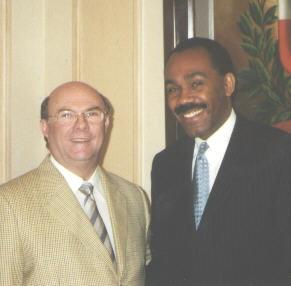
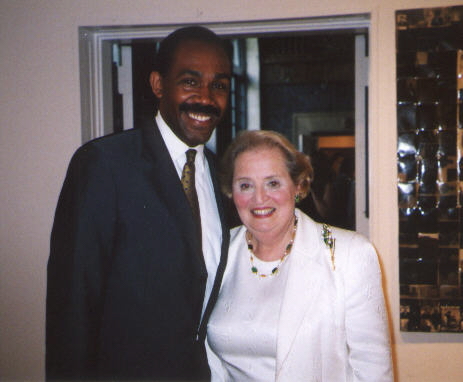
Oriel Jean, former President Aristide’s security chief, was gunned
down on March 2 in Delmas, Haiti. The popular belief in Haiti is that the
murder is linked to his upcoming testimony against former President Aristide in
Haitian court. Aristide is facing trial for money laundering and the murder of
Haitian journalist, Jean Dominique, in 2000. The evidence in Jean’s murder
investigation points to a premeditated strike. Police sources told reporters
from Le
Nouvelliste, Haiti’s national newspaper, that this killing was well planned.

Oriel Jean was a key witness in a judicial
case linking former President Jean Bertrand Aristide to drug trafficking
and money laundering in the United States as well as a key witness in two judicial
cases in Haiti implicating Aristide: one in the killing
of journalist Jean Dominique and the other on money laundering, drug
trafficking and corruption.

The wheels of Haitian justice are turning slowly, but surely.
Since the Superior Council of Judiciary Power (CSPJ) was installed three years
ago under new rules that no longer allow them to be fired by the Executive
Branch, Haitian judges have demonstrated a newfound courage in the pursuit of
justice and have developed a new level of independence that is healthy for
Haiti’s democratic development. But it is an uphill battle for these judges.
They are facing dangerous threats from those with power and money and an aggressive
and powerful
lobbying campaign in the U.S.
seeking to protect corrupt foreign interests linked to the Haitian mob bosses
and economic cartels.
Inside the Aristide Trials
After Jean’s arraignment
and trial he was sentenced
by U.S. District Judge Jose Martinez in 2005. His prison sentence was reduced by
a plea deal in which he provided extensive firsthand information on the
networks of organized crime, drug trafficking and money laundering in Haiti. His
testimony implicated former President Aristide in drug trafficking and money
laundering. After serving out a two and a half year sentence, he returned to
Haiti in 2012.
Meanwhile in Haiti, Aristide is facing three indictments
and was summoned by two magistrate-investigating judges in 2011, 2012 and 2013.
The first indictment was issued by Judge Ivickel Dabresil who is trying the
case on the murder of Jean
Dominique in 2011. One of the key witnesses in this case was Oriel Jean who
provided testimony
on how Aristide planned and killed Dominique. After a lengthy investigation, Judge
Dabresil ordered the indictment and detention of nine Aristide associates implicated
in the murder:
·
Mirlande Liberus the former head of Aristide’s
“democracy foundation” now in Florida, protected by Aristide lobbyist, lawyer
and business associate, Ira Kurzban
·
Aristide’s voodoo priest, Annette Auguste, alias
Sô Ann, the former deputy mayor of Port au Prince
·
Frantz Camille, alias Franco Camille, a well
known Aristide henchmen
·
Gabriel Harold Sévère
·
Jeudy Jean Daniel
·
Markenton Michel
·
Mérité et Dimsley Milien
·
Toussaint Merdique
The court was prepping for the final proceedings when Oriel
Jean was executed. SOS Journalists and the Independent Commission to Support
Investigations into Murders of Journalists (CIAPEAJ), two organizations leading
the charge to seek justice for Jean Dominique, denounced and condemned
the assassination calling upon the authorities to ensure that Dominique’s murder
does not go unpunished in light of this major setback.
The other trial in which Jean was a key witness was the corruption,
drug trafficking and money laundering trial. Judge Lamarre Belizaire conducted
a far-reaching investigation that unveiled corruption and kickbacks in Haiti’s
telecom sector, which has significant foreign political implications. The
investigation revealed stolen state funds, drug trafficking and money
laundering. Jean had a wealth of firsthand information as he served as Aristide’s
confidante and right hand man at that time.
Aristide’s Violent Response
In the course of the judges’ investigations, Aristide
responded with a campaign of violence, intimidation and a well-coordinated
public relations campaign in-country and abroad executed by his lobbyists in Washington, DC
and Kim Ives his mouthpiece and the
same lobbyists and associates
he made millionaires during his corrupt tenures as president.

Judge Belizaire’s wife, kids and parents were subjected to
violent intimidation and a vicious media campaign in an effort to get him to
back down. The judge was directly threatened, and there was an attempt on the
life of his warrant server – the same server who delivered warrants to
Aristide’s residence. Due to extensive foreign pressure, the Haitian police
never executed the warrant.
Manipulating the State Department and Blackmailing the Clintons
Through his lobbyists in Washington, DC, Aristide made it
clear to the Haiti coordinator at the US State Department that he and his
supporters would “burn down half of Port-au-Prince” if these warrants were
executed. Aristide claims that he enlisted US Representative Maxine Waters’ (D-CA)
office to press this individual at the State Department into injecting US
political pressure into the process by weighing in with the Haitian Government against
the trials and warrant executions. Many in Haiti could construe this
intervention as U.S. policy only taking people in Haiti seriously if they
threaten violence – a dangerous message for the future of democracy.

In addition, Aristide spread the word that he can blackmail
those in the US
that were involved in the telecom deals when he was President. He has threatened
to provide details on the recently surfaced stories about these same
individuals’ involvement in a sweetheart
deal involving Haiti’s USD$40 billion 24 karat gold mine as well as
linkages between that concession and the deployment of billions of dollars
allocated for recovery from Haiti’s 2010 earthquake.

Among those implicated is
Secretary Hillary Clinton’s brother, Tony
Rodham. In Haiti, Aristide claimed that the Clinton knew about the gold
mine since 1994 when the former President instructed the US military to blow up
the Bossa Mountain in the North East of Haiti. In April 2014, Aristide sent
Newton St Juste, a lawyer from his Lavalas party, to the Haitian General
Accounting Office to request an investigation
into former President Bill Clinton and former Secretary Clinton’s oversight of
the $4 billion donated by the State Department to Haiti and the funds collected
by the Clinton Foundation for Haiti from Algeria ($500,000), Qatar ($20
million), and other foreign countries. There are questions about the
multilateral funds they received from the IDB,
World Bank and other institutions. And, there are further questions about private
funds donated by wealthy individuals, including Mexican billionaire Carlos Slim
and Canadian Mogul Franck Giustra who each gave $100 million.

The tragedy here is that this was real money; money that
could have been a game changer in Haiti. Yet after all this money was collected
and all the attention brought by the earthquake, by every single person’s
account, Haiti is absolutely no better off than it was before. Building Back
Better never materialized.
Déjà Vu All Over Again
This is not the first time a witness involved in an Aristide
case has been executed. Venel Joseph, Aristide’s former Governor of the Central
Bank in Haiti agreed to testify in Miami against him in the Haiti telecom scandal
and money laundering. After the Miami Herald wrote
about his upcoming collaboration with the US judicial system, he was gunned
down in Haiti on the eve of his trip to Miami. Joseph’s son, who was the
head of Teleco, was already cooperating with Miami judicial authorities and
provided substantial information as part of a plea deal. Joseph had detailed information
on and extensive involvement in the kickbacks given during his tenure as
Haitian Central Bank Governor and his role as Chairman of the Teleco Board of
Directors.

In another instance, Aristide had prominent businessman
Bernard Lauture killed, and
when his wife tried to seek justice for her husband’s murder in Haiti, Aristide
sent one of his henchmen to threaten her saying that if she pursued the case,
he would have her children killed next. Mrs. Lauture fled the country with her
children and pursued justice from Europe. She was able to get partial justice
because the French Government extradited one of the Aristide’s henchmen
involved in the killing, Amaral Duclona, was sentenced to jail for the murder
of a French Consul in Haiti. Madame Lauture’s public testimony over Haitian
radio is available here.
Each time Aristide orders a hit, he tries to cover his
tracks by using his propaganda machine to fabricate stories of a poor
persecuted priest that enjoys the popular support of the people. This time
after Oriel Jean assassination his chief story fabricator, Kim Ives, has already
pushed out a story
about how US intelligence killed Oriel Jean. With no evidence or motive, this
lie is meant only to engage the fringe groups that support Aristide in the US
and Haiti.
To What End?
The end game for Aristide
is to create enough chaos so he can forge a coup against President Michel Martelly
and reinstate his regime. He
envisions installing his wife, who is an American citizen and legally unqualified
to serve, as the figurehead. His efforts to evade justice are part of a
multi-pronged strategy leveraging violence and undermining the organization of
Haitian elections while turning Martelly into the fall guy for the failure to
organize the municipal and Legislative elections.
Meanwhile, Haitians continue to reject him despite the
external pressure of the corrupt foreign interests that Aristide is
blackmailing. Upon his return from exile in 2010, the Haitian people welcomed
him back by looting his home – stealing even the mangoes on the trees – the night
before his arrival. And, his Lavalas party enjoys about a 5% approval rating.
In spite of Aristide’s violent campaign, Haiti’s electoral
process is moving forward.
The Provisional Electoral Council (CEP) is in place and the electoral decree
has been issued. The final electoral calendar will be published next week. And
so, Haiti is once again at a critical, fragile juncture. While Aristide may
believe that his violence and intimidation will work as it has over the past
two decades, Haitians are proving him wrong. Judges are standing up for
justice, and the people are standing down from their support of his leadership,
which by every measure was a complete failure. Like rulers before him who
employed violence, executions, intimidation, threats, blackmail,
Aristide truly believes that he is above the law and is seemingly unaware of
the trend toward justice. Perhaps he should study the fate of Saddam Hussein or
Hosni Mubarak and watch carefully the fate of Vladimir Putin.